
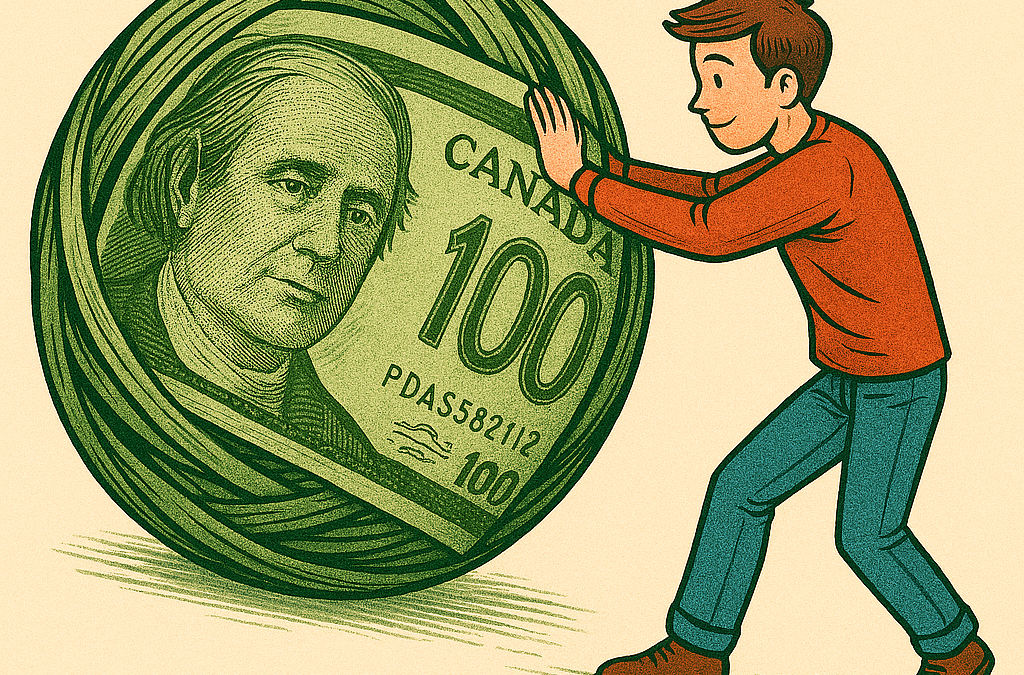
My philosophy is to Think Simple. I have found after 50 years, that this philosophy works for even the most complicated situations. Especially for accumulating wealth. But as with most simple things, people don’t do them because they believe that if it is that simple, it can’t work. Nothing can be further from the truth. Especially when it comes to Getting Rich. There are only 3 Simple rules you need to know AND FOLLOW.
Rule #1. IT IS NOT HOW MUCH YOU MAKE, BUT HOW MUCH YOU SAVE!
Rule # 2. ALWAYS MAKE YOUR SAVINGS WORK AS HARD AS POSSIBLE!
Rule # 3. SAVE EARLY, SAVE OFTEN!
Let’s look at rule 1 in this post. Rule #1. IT IS NOT HOW MUCH YOU MAKE, BUT HOW MUCH YOU SAVE! It really makes sense. If you make $60,000.00 a year and save $1000.00 you are way better off than someone who makes $200,000.00 and spends $205,000.00. They are in the hole by ($5000.00) at the end of the year. So why don’t more people save?? There are 6 major reasons.
- Present bias — today feels more real than tomorrow
People naturally overweight immediate rewards and underweight future benefits. A $20 impulse purchase feels good NOW; the payoff of saving feels abstract and distant. Besides, $20.00 doesn’t make a difference if I save it. Not true. If you save $20.00 a month that is $240.00 a year. You can get into your first Mutual Fund for between $50.00 and $100.00. - Lifestyle creep — spending rises with income
As earnings grow, expectations grow with them. Upgrades feel justified (“I work hard, I deserve this”), and the new baseline becomes the norm, leaving no surplus to save. This also makes sense. I am not going to suggest that you save the whole amount of a raise. But what if you saved 10% of the raise? You get a $100 a month raise, why not save $10.00 a month of it. That would be an additional $120.00 a year. For food service people save 10% of your TIPS. - No automatic systems — saving requires willpower
When saving depends on manual decisions, it competes with fatigue, stress, and daily distractions. Automation removes friction, but many people never set it up. It is so easy to set up. You might even be able to do it on your phone. It is called automated saving. Your Bank/Credit Union would LOVE to do this for you. They really want you to SAVE. Get them to take $10.00 every time you get paid and put it into a TFSA or at least a Savings account. It is automatic and requires no effort on your part. A great way to save used to be “ROUNDING” If you made a debit card purchase of $4.90. Your account would be debited for $5.00. $4.90 would go to the merchant and 5 Cents would go into your savings account. My students who have used this say it is the best. You just don’t notice that your saving. - Emotional spending — money becomes a coping tool
Stress, boredom, and social comparison push people toward purchases that provide short-term relief. Without emotional awareness, spending becomes reactive rather than intentional. SPENDING MONEY SHOULD NOT MAKE YOU FEEL BETTER! Do you really feel better because you just made yourself more POOR??? - Lack of clarity — no defined goals or numbers
When you don’t know what you’re saving for or how much the you need, saving feels optional. Clear targets create purpose and make trade-offs easier. Set a target for yourself. Keep it reasonable. Say saving $240.00 this year. ($20.00 a month). When you reach the goal, increase it by 50% ( to $360.00 a year or $30.00 a month) - Small amounts are not worth it. It might seem that saving $5.00 isn’t worth it. Nothing could be more wrong. Ever built a snowman? You start with a small handful of snow. Then you roll it, it keeps getting bigger. If you roll it long enough, it gets so big you can’t move it. Saving is just the same. Don’t give up ROLLING.
If you need help figuring out how or how much to save, send me an email. I will not bug you I will just help you.